Thursday, May 28, 2020

What is the historical significance of Ghar e Hira?


During his youth, the Holy Prophet (peace be upon him) travelled to several places in Syria and Palestine in the capacity of a merchant. In between his commercial undertakings, he also worked as a shepherd. This afforded him the opportunity for quiet thought and meditation far from the maddening crowds of makkah.


When the Holy Prophet (peace be upon him) was nearly forty years of age, one night while seated in deep thought and meditation in the cave of the Mount Hira, Hazrat Jibrail or the angel Gabriel (may God be pleased with him) came to him with a piece of silk brocade on which some words were written and said, “Read”. The Prophet (peace be upon him) replied, “I cannot read!” But the angel repeated his words three times and said:

“Read in the name of thy Lord who created
Man from blood coagulated
Read! Thy Lord is wondrous kind
Who by the pen has taught mankind
Things they knew not, being blind.”

This was the first revelation. It affected the Holy Prophet (peace be upon him) so deeply that he trembled all over and turned pale. He rose from his seat and hurried home where he related the incident to his wife – Hazrat Khadija bint Khuwaylid (may God be pleased with her). She comforted him and told him that he was the Prophet. In order to confirm her opinion, she went to her cousin, Waraqa bin Naufal, who was a ‘hanif’ or monotheist. This meant that he still followed the same uncorrupted religion of the Prophet Abraham (peace be upon him). He also supported her. Encouragements from his wife and her cousin comforted Hazrat Muhammad (peace be upon him).

There after the Holy Prophet (peace be upon him) received the message of the God Almighty through the angel Gabriel that he was the Messenger of Allah and His Rasul. And that he was to deliver the message of Islam to the idolaters of Makkah in particular and the non-Muslims of the world in general. The Prophet (peace be upon him) returned and busied himself with the increasing burdens of prophet hood. He stood at the threshold of the most critical period in his own life and the history of the world. At first he conveyed the message privately to the close circle of his relatives and friends. But later on the message was spread in all directions. Thus God perfected religion. Sensible minds in Arabia understood that the mission of the Holy Prophet (peace be upon him) was true and free from any worldly ambitions.


Not only was Mount Hira the choicest refuge of Hazrat Muhammad (peace be upon him) but it also became a much frequented ziyarat in subsequent centuries.

The Mount itself would be known as Jabal e Noor or the Mountain of Light. Particularly during the Hajj season is this cave visited by pilgrims in large numbers. But Umrah pilgrims keep visiting it off and on throughout the year. Devotees of the Holy Prophet (Ashiq e Rasool) climb the rock to reach the top where the cave is located. Strictly following the way of the Prophet (peace be upon him), they climb the steep enthusiastically and make the descent anxiously. By no means is this the only way, or the compulsory way. Pilgrims can climb and descend the way they like it or in a way that is not hazardous to their health. This is just for those who wish to see the Cave of Hira from inside and in accordance with the Sunnah.

The Mount Hira is only three kilometres away from Makkah at the end of the Jabal An Nur Road. Vehicles may or may not go beyond Bilal bin Rabah Mosque. This is where the said road terminates and the Ghar e Hira Trail begins. The passage is about half a kilometre of unpaved dirt road and may not be for everyone


.Mount Hira
Mount Hira
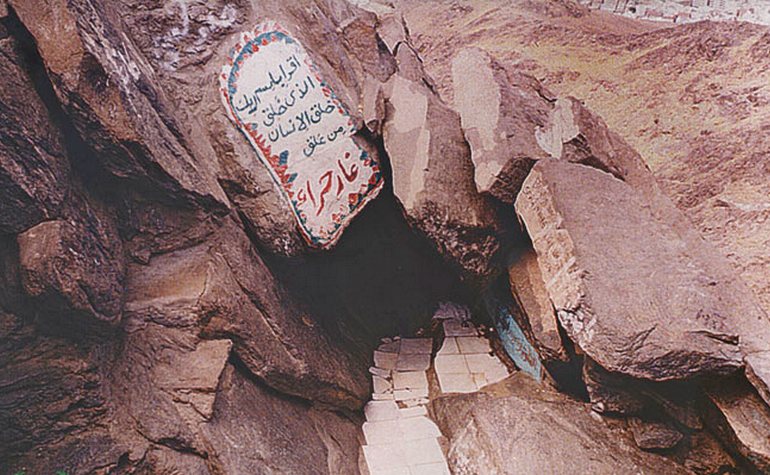
This is Mount Hira (Jabal Hira), which lies about two miles from the Ka’bah. Near the top is a small cave, a little less than 4 meters in length and a little more than one and a half meters in width. It was here that the Prophet Muhammad (ﷺ) received the first revelations of the Holy Quran during the month of Ramadhan in 610 CE. The mountain is also known as Jabal Noor (the Mountain of Light).

The Prophet (ﷺ) first began to have revelations in the form of good dreams which came true. Then he began to like solitude. He would go to the cave of Hira and meditate there in solitude for a number of days and nights. He would take provisions with him to stay for an extended period, and when he returned to Khadija (رضي الله عنه), he would stock up again and go back to the cave. This was his practice until Truth was revealed to him by an angel while he was in the cave of Hira.


The entrance to the cave of Hira
During Tahajjud time one night, when he was alone in the cave, there came to him an angel in the form of a man. The angel said to him, “Recite!”. “I cannot read”, the Prophet (ﷺ) replied. The angel took hold of him a second time and pressed him until he could not endure it any longer. After letting him go, the angel again said, “Recite!”. Again the Prophet (ﷺ) replied “I cannot read”. The angel further embraced him again until he had reached the limit of endurance and said “Recite!” for the third time the Prophet (ﷺ) said “I cannot read”. The angel released him and said: “Read in the name of your Lord, the Creator. He Who created man from a clot. Read! And your Lord is the Most Bounteous. Who taught by the Pen, taught man what he knew not.” [96:1-5]

This was the first day of his Prophethood and these were the first verses of the Quran revealed to him. He recited these words after the angel, who thereupon left him; and he said; “It was as though the words were written on my heart.” He was very alarmed by the experience and feared that he had become possessed.

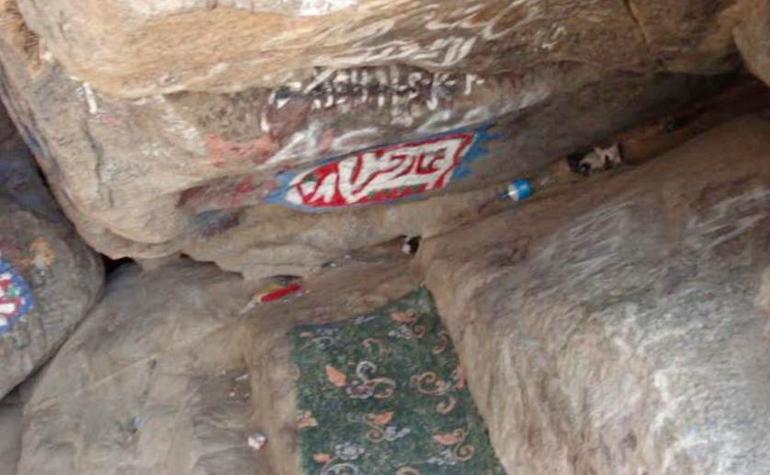
Interior of the Cave of Hira

The Prophet (ﷺ) fled from the cave, and when he was halfway down the slope of the mountain he heard a voice above him saying: “O Muhammad, thou art the Messenger of God, and I am Jibraeel (Gabriel)”. The Prophet (ﷺ) stood gazing at the angel; then he turned away from him, but whichever way he looked the angel was always there on the horizon, whether it was to the north, east, south or west. Finally the angel turned away. The Prophet (ﷺ) was terrified and his heart was pounding hard. He returned home to Khadija (رضي الله عنها) and said, “Cover me!”. Khadija (رضي الله عنها) covered him and helped him calm down.

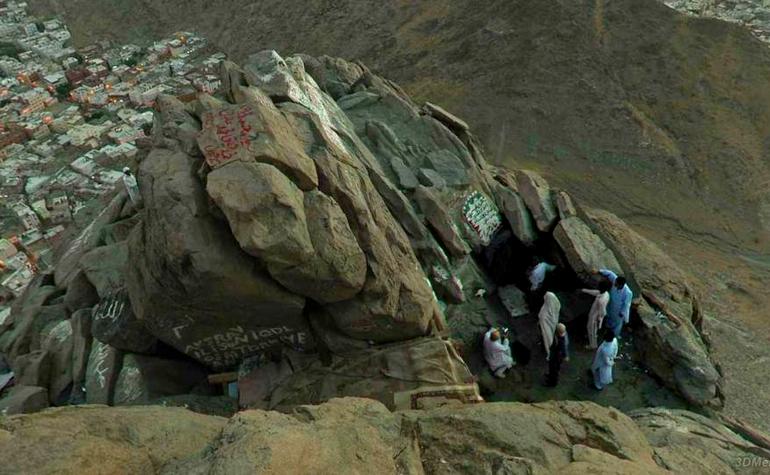
The cave of Hira from above

The Quran tells us that the first revelation descended in Ramadan on the ‘Night of Power’.“The month of Ramadan is the month in which the Quran was revealed.” [2:185]
“We have indeed revealed this message during the Night of Power.” [97:1]
The entire Quran was revealed over a period of approximately 22 years, 5 months a
nd 14 days.

The Fundamentals of Islamic Belief


One could be forgiven for assuming that any group with the word Islam in its title would be Muslim.  But when it comes to the group calling itself the “Nation of Islam”, one must be very wary indeed.  To be Muslim means to hold certain fundamental theological beliefs.  The Muslim profession of faith is:


“I bear witness that there is no god but God, and I bear witness that Mohammed is a prophet of God.”

To elaborate on these statements, to be a Muslim means to believe that God is One, unique.  He has no partners, no associates, no Son, nor did He ever become incarnate.  As chapter 112 of the Quran makes clear:

“He is God, the only One,

God the Everlasting.

He did not beget and is not begotten,

And none is His equal.”

In Islam the ascribing of partners to God, referred to as shirk, is the greatest of all sins.  The Quran states explicitly in chapter 4, verse 36:

“Serve God, and join not any partners with Him.”

Secondly, Muslims believe Mohammed to have been the “Seal” or last of the prophets.  To recognize anyone after Mohammed claiming to be a prophet, negates one’s Islam.  As is stated in the Quran:

“O people!  Mohammed has no sons among ye men, but verily, he is the Messenger of God and the last in the line of Prophets. And God is aware of everything.” (Quran 33:40)

This is reinforced by various sayings of Prophet Mohammed, may the mercy and blessings of God be upon him:

“The tribe of Israel was guided by prophets. When a prophet passed away, another succeeded him. But no prophet will come after me; only caliphs will succeed me.” (Saheeh Al-Bukhari)

“In My Ummah, there shall be born Thirty Grand Liars (Dajjals), each of whom will claim to be a prophet, But I am the Last Prophet; there is No Prophet after Me.” (Abu Dawood, At-Tirmidhi)

The Errant Theology of the “Nation of Islam”


The “Nation of Islam” does not adhere to these core tenets of Islamic theology.  They believe that God appeared on earth in the person of their founder, a “great man from the East”, Master W. Fard Muhammad, a preacher who first came to public attention in the USA on July 4, 1930 then mysteriously “departed the scene” on February 26, 1934.  As the NOI website unambiguously declares:

“WE BELIEVE that Allah (God) appeared in the Person of Master W. Fard Muhammad, July, 1930; the long-awaited “Messiah” of the Christians and the “Mahdi” of the Muslims.”

In 1934 following the unexplained departure of the “Master”, the organization he founded came to be headed by one Elijah Poole, who became known as the Honorable Elijah Muhammad.  Until very recently, the “Nation of Islam” accorded the status of prophet to Elijah Muhammad.

Therefore it is clear that despite their name and calling themselves Muslims, “Nation of Islam” beliefs about God and prophethood are glaringly incompatible with Islam.

Louis Farrakhan, current leader of the Nation of Islam, finally allowed to enter the UK after a court orders the lifting of a 15-year government ban.

“Honorable” Elijah Muhammad, the “prophet” of the Nation of Islam.

“Master” W. Fard Muhammad in whose person God appeared in early 1930’s America, according to Nation of Islam beliefs.


 Racist ideology also at odds with universal Islam


A third area of non-compliance with Islam, and the one which receives by far the greatest attention in the secular media, is the issue of race.  The present “Nation of Islam” leader, Louis Farrakhan, is on record as having made objectionable anti-Jewish (as distinct from anti-Zionist) remarks.  Among other unfortunate utterances, he is alleged to have referred to Judaism as a “gutter religion”.

Moreover, the NOI is a segregationalist organization exclusively for black people descended from slaves.  Proper Islam is a universal religion open to people of every race.  Muslims are supposed to differentiate between people on the basis, not of ethnic origin, but of piety and upright behavior.  As the Quran makes clear:

“And mankind is naught but a single nation.” (Quran 2:213)

“O Mankind!  Most certainly, it is We (God almighty) who have Created you all from a single (pair) of a male and a female, And it is We who have made you into nations and tribes, that ye may recognize each other.  Verily, the noblest of you in the sight of God is (he who is) the most righteous of you.” (Quran 49:13)

And in his final sermon, Prophet Mohammed made clear that racism has no place in Islam:

“O people!  Verily your Lord is one and your father is one. All of you belong to one ancestry of Adam and Adam was created out of clay. There is no superiority for an Arab over a non-Arab and for a non-Arab over an Arab; nor for white over the black nor for the black over the white except in piety. Verily the noblest among you is he who is the most pious.”

In contrast, the NOI has a pronounced anti-white bias.  They refer to blacks as God’s chosen people and Caucasians as white devils.  They call for a separate homeland for American blacks, for racially segregated education and for a ban on interracial marriage.  To quote again from their website:

We believe we are the people of God’s choice.

WE BELIEVE this is the time in history for the separation of the so-called Negroes and the so-called white Americans.

We want our people in America whose parents or grandparents were descendants from slaves, to be allowed to establish a separate state or territory of their own--either on this continent or elsewhere.

We want all black children educated, taught and trained by their own teachers.

We believe that intermarriage or race mixing should be prohibited.

Wednesday, May 13, 2020

FLIGHT JANAZAH

When we are leaving this world for the next one, it shall be like a trip to another country.Where details of that country won’t be found in glamorous travel brochures but in the Holy Qura’an and the Hadiths.Where our plane won’t be Indian Air Lines, British Airways, Gulf Air or Emirates but Air Janazah.

Where our luggage won’t be the allowed 30 Kgs but our deeds no matter how heavy they weigh.


You don’t pay for excess luggage. They are carried free of charge, with your Creator’s compliment.Where our dress won’t be a Pierre Cardin suit or the like but the white cotton shroud.Where our perfume won’t be Channel, Paco Rabane, but the camphor and attar.Where our passports won’t be Indian, British, French or American but Al Islam.                                                                                                                                                                                                                                         

Where our visa won’t be the 6 months leave to stay or else but the “La Illaha Illallah”. Where the airhostess won’t be a gorgeous female but Isra’iil and its like. Where the in-flight services won’t be 1st class or economy but a piece of beautifully scented or foul smelling cloth. Where our place of destination won’t be Heathrow Terminal 1 or Jeddah International Terminal but the last Terminal Graveyard. Where our waiting lounge won’t be nice carpeted and air-conditioned rooms but the 6 feet deep gloomy Qabar.


Where the Immigration Officer won’t be His Majesty’s officers but Munkar and Nakeer. They only check out whether you deserve the place you yearn to go. Where there is no need for Customs Officers or detectors. Where the transit airport will be Al Barzakh. Where our final place of destination will be either the Garden under which rivers flow or the Hellfire.

This trip does not come with a price tag. It is free of charge, So your savings would not come handy. This flight can never be hijacked so do not worry about terrorists. Food won’t be served on this flight so do not worry about your allergies or whether the food is Halal. Do not worry about legroom; you won’t need it, as our legs will become things of the past. Do not worry about delays. This flight is always punctual. It arrives and leaves on time. Do not worry about the in-flight entertainment program because you would have lost all your sense of joy. Do not worry about booking this trip, it has already been booked (return) the day you became a foetus in your mother’s womb.

Ah! At last good news! Do not worry about who will be sitting next to you. You will have the luxury of being the only passenger. So enjoy it while you can. If only you can! One small snag though, this trip comes with no warning. Are you prepared…..you better be ! Please spread the truth and Insha-Allah our Muslim brothers & sisters will understand and practice the guiding principles, whatever way they can afford to uphold our believe of our religion Islam in this world and in the hereafter.

regard to issues of shirk and kufr


Praise be to Allah

With regard to the ignorant person who does acts of kufr or shirk, one of the following two scenarios must apply:


-1-

The first scenario is: he is not Muslim, whether he follows another religion or does not have a religion.

If that is the case, then such a person is a disbeliever, whether he knows what he is doing or is ignorant, or he is basing his disbelief on some misinterpretation. He is not subject to the same rulings as a Muslim in this world, and he is subject to the rulings on disbelievers, because he has not entered Islam in the first place, so how can we deem him to be Muslim when he has never claimed to be Muslim?

With regard to the hereafter, if he was truly ignorant, and the call of Islam never reached him at all, or it reached him in a distorted manner in such a way that proof is not established against one like him, then with regard to his fate on the Day of Resurrection, there was a lengthy debate among the scholars.

The most correct scholarly view concerning him is that he will be tested on the Day of Resurrection. Then whoever obeys Allah will enter Paradise, and whoever disobeys Him will enter Hell.

There are numerous reports which state that in the case of a person whom with the message did not reach in this world, a messenger will be sent to him on the Day of Resurrection.

End quote from Majmoo‘ al-Fataawa (17/308)

This has been discussed previously in the answers to questions no. 1244 and 215066

-2-

The second scenario is: he claims to be a Muslim and fulfils the conditions of being described as such, and he openly declares his complete belief in Islam and his belief in the Messenger (blessings and peace of Allah be upon him).

In the case of such a person, if he does a deed that makes him a disbeliever out of ignorance, he is not to be deemed a disbeliever because of that, and the description of being Muslim is not to be taken away from him, unless proof that he is wrong is established and is explained to him.

With regard to anyone who believes in Allah and His Messenger and remains steadfast in obeying them, but denies some of that which the Messenger brought, out of ignorance or lack of knowledge that the Messenger brought it – even though that constitutes disbelief and the one who does it is a disbeliever – the fact that he was ignorant of what the Messenger brought makes it disallowed to deem that particular person a disbeliever, regardless of whether the matter has to do with a fundamental or minor issue, because disbelief means rejecting what the Messenger brought, or rejecting some of it, knowingly.

Thus you may know the difference between the disbeliever who disbelieves in the Messenger and the believer who rejects some of what he brought out of ignorance and misguidance, not knowingly and out of stubbornness.

End quote from al-Fataawa as-Sa‘diyyah (p. 443-447) The excuse of ignorance is something that is valid and established with regard to all issues of religion, whether they are issues of belief, tawheed and shirk, or issues of fiqhi rulings.

The fact that a Muslim may be excused for ignorance with regard to matters of belief is indicated by several points of shar‘i evidence, as follows:                                                                              


                                                                                                                                                                          1.

The shar‘i texts which indicate that the one who makes mistakes is excused, such as the verse in which Allah, may He be exalted, says (interpretation of the meaning): “Our Lord! Punish us not if we forget or fall into error” [al-Baqarah 2:286]. And Allah, may He be exalted, said [in a hadith qudsi]: “I have granted that”, as is narrated in Saheeh Muslim (126).

And Allah, may He be exalted, says (interpretation of the meaning): “And there is no sin on you if you make a mistake therein, except in regard to what your hearts deliberately intend. And Allah is Ever Oft-Forgiving, Most Merciful” [al-Ahzaab 33:5].

And the Prophet (blessings and peace of Allah be upon him) said: “Allah has forgiven my ummah their mistakes and forgetfulness, and what they are forced to do.” Classed as hasan by al-Albaani.

These texts indicate that whoever does something that is contrary to what he is obliged to do, because he forgot or out of ignorance, is to be pardoned. The one who is mistaken also includes the one who is ignorant, because the one who is mistaken is anyone who does something contrary to the truth without intending to.

Shaykh ‘Abd ar-Rahmaan as-Sa‘di said: This is general in meaning and applies to every case in which the believers make mistakes, whether it has to do with deeds or beliefs.

End quote from al-Irshaad ila Ma‘rifat al-Ahkaam (p. 208)

Shaykh Ibn ‘Uthaymeen (may Allah have mercy on him) said: Ignorance is undoubtedly a mistake. Based on that, if a person does something that constitutes disbelief, in word or deed, not knowing that it constitutes disbelief – i.e., he is ignorant of the shar‘i evidence – then he is not to be deemed a disbeliever.

Shaykh al-Islam Ibn Taymiyah said: Allah, may He be exalted, said in the Qur’an (interpretation of the meaning): “Our Lord! Punish us not if we forget or fall into error” [al-Baqarah 2:286]. And Allah, may He be exalted, said [in a hadith qudsi]: “I have granted that”, And He did not differentiate between mistakes with regard to definitive issues or issues based on probability… So whoever says that the one who is mistaken with regard to definitive issues or issues based on probability is sinning has gone against the Qur’an, the Sunnah and the consensus of the early generations.

End quote from Majmoo‘ al-Fataawa (19/210).

And he said: Moreover, my attitude – and those who have spent time with me know that about me – is that I am the one who most emphatically forbids deeming a specific person to be a disbeliever, evildoer or sinner, unless it is known that definitive proof has been established against him, of the kind of proof that anyone who goes against it or rejects it becomes a disbeliever, evildoer or sinner. I affirm here that Allah has forgiven this ummah for their mistakes, which includes mistakes in issues of beliefs, words and practical actions.

End quote from Majmoo‘ al-Fataawa (3/229)

Ibn al-‘Arabi said: With regard to the ignorant and those who make mistakes among this ummah, even if they do acts that constitute disbelief and shirk, the kind of deeds that result in the doer being deemed a mushrik or a disbeliever, they are to be excused for their ignorance and mistakes until proof is established against them, of the type of proof that whoever rejects it becomes a disbeliever and it is clearly explained to the degree that a man of his calibre would not be confused after such an explanation. End quote. This was narrated from him by al-Qaasimi in Mahaasin at-Ta’weel (3/161).

Shaykh ‘Abd ar-Rahmaan al-Mu‘allimi said: Even if we sometimes say that this is calling upon someone other than Allah, may He be exalted, and it is an act of worship and shirk, we do not mean that everyone who does that is a mushrik. Rather the mushrik is the one who does that with no excuse. As for the one who does that with an excuse, then perhaps he is one of the best slaves of Allah, may He be exalted and one of the most virtuous and pious.

End quote from Athaar ash-Shaykh ‘Abd ar-Rahmaan al-Mu‘allimi (3/826)

2.

The texts indicate that Allah’s proofs against people cannot be established except after they have knowledge of the proof, such as the verses in which Allah, may He be exalted, says (interpretation of the meaning):

“And We never punish unless We have sent a Messenger”

[al-Isra’ 17:15]

“Messengers as bearers of good news as well as of warning in order that mankind should have no plea against Allah after the Messengers. And Allah is Ever All-Powerful, All-Wise”[an-Nisa’ 4:165]“And Allah will never lead a people astray after He has guided them until He makes clear to them as to what they should avoid”

[at-Tawbah 9:115]

and there are other verses which indicate that proof cannot be established except after knowledge and clear explanation. These verses indicate that the accountable person is not required to carry out Islamic duties except having acquired knowledge concerning them. If he does not know of them, then he is excused.

Shaykh Ibn ‘Uthaymeen said, explaining what we learn from this verse, “Messengers as bearers of good news as well as of warning…” [an-Nisa’ 4:165]:

The most important thing we learn is that the excuse of ignorance is a valid excuse, even with regard to the fundamentals of religion, because the Messengers brought both fundamental and minor issues, so if a person is ignorant and no messenger came to him, then he has an excuse before Allah.

End quote from Tafseer Soorat an-Nisa’ (2/485).

Ibn al-Qayyim said:

The shar‘i rulings only become binding upon a person when he reaches puberty and when the rulings reach him. Just as the rulings are not binding upon him before he reaches puberty, by the same token they are not binding upon him before they reach him.

End quote from Badaa’i‘ al-Fawaa’id (4/168).

Shaykh al-Islam Ibn Taymiyah (may Allah have mercy on him) said in ar-Radd ‘ala al-Ikhnaa’i, annoted by al-‘Anzi (p. 206):

Similarly, if a person calls upon someone other than Allah and performs the Hajj rituals for someone other than Allah, he is also a mushrik, and his actions constitute disbelief, but he may not be aware that this is shirk which is forbidden.

When many of the Tatars and others entered Islam, they had small idols made of felt and other things, which they sought to draw close to and venerated. They did not know that this was prohibited in the religion of Islam. They would also seek to draw close to (and worship) fire, not knowing that doing so is prohibited. There are many kinds of shirk which some of those who enter Islam may be unaware of and not realise that it is shirk. Such a person is misguided and the deed in which he associates others with Allah is invalid, but he does not deserve to be punished unless proof is established against him. Allah, may He be exalted, says (interpretation of the meaning): “Then do not set up rivals unto Allah (in worship) while you know (that He Alone has the right to be worshipped)” [al-Baqarah 2:22]. End quote.

3.

The texts which tell the stories of some who fell into shirk or disbelief but were excused. They include the following:

(i) The story of the man who issued instructions that his body was to be burned and who denied the power of Allah over him

It was narrated from Abu Hurayrah (may Allah be pleased with him) that the Prophet (blessings and peace of Allah be upon him) said: “There was a man who transgressed against his soul (by committing a great deal of sin). When he was dying he said to his sons: ‘When I die, burn me, then grind my bones, then scatter me in the wind, for by Allah, if my Lord grasps hold of me, He will punish me as He has never punished anyone else.’ When he died, that was done to him, but Allah commanded the earth: ‘Gather together whatever of him there is in you.’ So it did that, then the man was standing there. Allah said: ‘What made you do what you did?’ He said: ‘O Lord, I feared You.’ So He forgave him.”

Agreed upon.

What this man said constituted major disbelief that puts one beyond the pale of faith, because it was an implicit denial of the power of Allah to gather his scattered dust after he died. Moreover the divine attribute of power is one of the most obvious and clear of divine attributes, which is obviously connected to the Lordship and divinity of Allah. In fact it is one of the most significant attributes of the Lord. But this man was not deemed a disbeliever, because he was excused for his ignorance.

Ibn ‘Abd al-Barr said: The scholars differed concerning the meaning of this hadith. Some of them said: This was a man who was ignorant of one of the attributes of Allah, may He be glorified and exalted, namely His power. So he did not know that Allah has power to do whatever He wills. They said: If a person is ignorant of one of the attributes of Allah, may He be glorified and exalted, but he believes in and knows all the other divine attributes, his ignorance of some of the attributes of Allah does not mean that he is to be deemed a disbeliever. And they said: rather the disbeliever is the one who stubbornly rejects the truth, not one who is ignorant of it.

This is the view of the earlier scholars and of later scholars who followed in their footsteps.

End quote from at-Tamheed lima fi’l-Muwatta’ min al-Ma‘aani wa’l-Asaaneed (18/42).

This was a man who had some doubts about the power of Allah and His ability to bring him back to life if his dust was scattered. Rather he believed that Allah would not be able to resurrect him, which constitutes disbelief according to Muslim consensus. But he was ignorant and did not know that, although he was a believer who feared that Allah would punish him. Therefore Allah forgave him for that.

End quote from Majmoo‘ al-Fataawa (3/23 1).

He also said:

This man believed that Allah would not be able to gather his dust if he did that, or he doubted that Allah could do that, and believed that He would not resurrect him. In both cases, such beliefs constitute disbelief, and the one for whom such proof has been established is to be deemed a disbeliever. But this man was ignorant of that and no knowledge had reached him to dispel his ignorance, yet he had faith in Allah and believed in His commands and prohibitions, His promises and warnings, and therefore he feared His punishment. So Allah forgave him because of his fear of Him.

If one of those who believe in Allah and His Messenger and the Last Day, and do righteous deeds, make some mistakes in their understanding of some issues of belief, they will not be worse off than this man. Allah may forgive their errors or He may punish them, if they fell short and do not make sufficient efforts to find out about the truth and follow it.

As for deeming a person who is known to have faith to be a disbeliever for simply making mistakes with regard to some issues of belief, that is a serious matter indeed.

End quote from al-Istiqaamah (1/164)

Allah has names and attributes that are mentioned in His Book, and of which His Prophet (blessings and peace of Allah be upon him) has told his ummah. No one to whom proof has been presented clearly can reject that, because they are mentioned in the Qur’an and are mentioned in saheeh reports from the Messenger of Allah (blessings and peace of Allah be upon him).

Therefore if a person goes against that after clear proof has been presented to him, then he is a disbeliever. However, before clear proof has been presented to him, he may be excused for his ignorance, because knowledge of such matters cannot be figured out on the basis of reasoning or on the basis of reflecting and thinking. We do not deem anyone to be a disbeliever for not knowing it, except after knowledge thereof reaches him.

End quote from Siyar A‘laam an-Nubala’ (10/79)

(ii) The story of the Children of Israel with Moosa

Allah, may He be exalted, says (interpretation of the meaning):

“And We brought the Children of Israel (with safety) across the sea, and they came upon a people devoted to some of their idols (in worship). They said: ‘O Moosa (Moses)! Make for us an ilahan (a god) as they have aliha (gods).’ He said: ‘Verily, you are a people who know not (the Majesty and Greatness of Allah and what is obligatory upon you, i.e., to worship none but Allah Alone, the One and the Only God of all that exists).’

(Moosa (Moses) added:) ‘Verily, these people will be destroyed for that which they are engaged in (idols-worship). And all that they are doing is in vain.’

He said: ‘Shall I seek for you an Ilahan (a God) other than Allah, while He has given you superiority over the Alameen (mankind and jinns of your time)?’”[al-A‘raaf 7:138-140].

They demanded that Moosa (peace be upon him) should make them an idol so that they could seek to draw close to Allah by worshipping it, as those mushrikeen had taken an idol for worship.

This shows how great their ignorance was, as they thought that it was permissible to worship something other than Allah, after they had seen the signs.

End quote from Zaad al-Maseer (2/150)

It seems from the response of Moosa (peace be upon him) that even though he denounced them for their ignorance, he did not regard their demand as apostasy from faith. This is supported by the fact that they were not taken to task at this point as they were taken to task when they took the calf for worship. It is as if in this instance – and Allah knows best – they were excused because they were new in their faith.

End quote from Majmoo‘ Rasaa’il al-Mu‘allimi (1/142)

(iii) The story of Dhaat Anwaat

It was narrated that Abu Waaqid al-Laythi said: We set out with the Messenger of Allah (blessings and peace of Allah be upon him) towards Hunayn, and we passed by a lote-tree. We said: O Prophet of Allah, make this into a dhaat anwaat for us as the disbelievers have a dhaat anwaat. The disbelievers used to hang (yanootoona) their weapons on a lote-tree and stay around it, showing devotion to it.

The Prophet (blessings and peace of Allah be upon him) said: “Allahu akbar! This is what the Children of Israel said to Moosa, ‘Make for us a god as they have gods’! You will certainly follow in the footsteps of those who came before you.”

Narrated and classed as saheeh by at-Tirmidhi (2180). It was also narrated by Imam Ahmad (21900) and classed as saheeh by Shaykh al-Albaani.

They asked the Prophet (blessings and peace of Allah be upon him) to do something that constituted shirk akbar (major shirk); they wanted him to prescribe for them to hang their weapons on trees, as the mushrikeen did. Hence the Prophet (blessings and peace of Allah be upon him) regarded their words as being akin to the words of the Children of Israel to Moosa.

Muhammad Rasheed Rida said: Those who said that to the Prophet (blessings and peace of Allah be upon him) were new Muslims who had recently given up shirk, so they thought that if the Prophet allocated something like that for that purpose, it would be acceptable and would not be contrary to Islam.

End quote from his comment on Majmoo‘ ar-Rasaa’il wa’l-Masaa’il an-Najdiyyah (4/39)

Shaykh ‘Abd ar-Razzaaq ‘Afeefi was asked about the grave-worshippers who believe in the dead and ask of them. The shaykh (may Allah have mercy on him) said: They are apostates from Islam, if proof is established against them. Otherwise they are excused for their ignorance, like those who asked for a dhaat anwaat.

End quote from Fataawa ash-Shaykh ‘Abd ar-Razzaaq ‘Afeefi (p. 371)

Shaykh al-Islam Ibn Taymiyah said:

After learning what the Messenger (blessings and peace of Allah be upon him) brought, we inevitably learn that he did not prescribe for his ummah to call upon any of the dead, whether they were Prophets, righteous people or anyone else, whether in the sense of seeking help or otherwise, whether by way of seeking refuge or in any other way.

Similarly, he did not prescribe for his ummah to prostrate to anyone, dead or otherwise, and the like. Rather we know that he prohibited all such things, and that these things come under the heading of shirk which Allah and His Messenger forbade.

But because of the prevalence of ignorance and lack of knowledge of Islamic teachings among many of the later generations, it is not possible to deem them disbelievers because of that, until they learn and find out what the Messenger (blessings and peace of Allah be upon him) brought, and what contradicts it.

End quote from ar-Radd ‘ala al-Kubra (2/731)

As for calling upon the occupants of the graves and seeking their help, and asking them to meet one’s needs and relieve distress, this is major shirk that puts one beyond the pale of Islam.

Such actions should be described as shirk and disbelief, but it should not be said that the one who does that is a mushrik and a disbeliever, because whoever does that and is ignorant is excused because of his ignorance, unless proof is presented to him and he understands it, then he persists in that. In that case he may be deemed to be a disbeliever and an apostate.

Confusion concerning graves is something that many people have fallen into, who were raised in an environment where venerating graves and calling upon their occupants was regarded as a sign of loving the righteous, especially if there was among them one of the pseudo-scholars who are leading the people in venerating graves and seeking the help of their occupants, claiming that they are mediators who will bring people closer to Allah.

End quote from Kutub wa Rasaa’il al-‘Allaamah al-‘Abbaad (4/372)

(iv) The hadith of Hudhayfah ibn al-Yamaan (may Allah be pleased with him)

It was narrated that Hudhayfah ibn al-Yamaan (may Allah be pleased with him) said: The Messenger of Allah (blessings and peace of Allah be upon him) said: “Islam will wear out as colour on a garment wears out, until no one will know what fasting, prayer, Hajj and charity (zakaah) are. The Book of Allah, may He be glorified and exalted, will be taken away at night, and not one verse of it will be left on earth. And there will be some people left, old men and old women, who will say: We saw our fathers saying these words, Laa ilaaha ill-Allah, so we say them too.”

Silah said to him: What good will (saying) Laa ilaaha ill-Allah do them, when they do not know what fasting, prayer, Hajj and charity are?

Hudhayfah turned away from him. He repeated his question three times, and Hudhayfah turned away from him each time.

Then he turned to him on the third time and said: O Silah, it will save them from Hell, three times.

Narrated by Ibn Maajah (4049), classed as saheeh by al-Buwaysiri in Misbaah az-Zujaajah (2/291); classed as saheeh by al-Albaani in Silsilat al-Ahaadeeth as-Saheehah (1/171).

This hadith indicates that those people will have nothing but faith in the general sense of affirming Tawheed; they will know nothing of Islam except simply affirming what they found their fathers saying.

Many people may grow up in places and times where a lot of the teachings of Islam are worn out, so that there is no one left to convey that with which Allah sent His Messenger of the Book and wisdom, so they do not know much of that with which Allah sent His Messenger, and there will be no one to convey to them. Such a person cannot be deemed a disbeliever, therefore the leading scholars are unanimously agreed that whoever is brought up in the wilderness, far away from people of knowledge and faith, and is new in Islam, and denies something of these obvious rulings that were established through mutawaatir texts, is not to be deemed a disbeliever until he learns what the Messenger brought.

End quote from Majmoo‘ al-Fataawa (11/407)

Conclusion:

The type of ignorance for which a person is excused is that whereby he does not know about the truth and no one mentions the truth to him. This may be a reason why he cannot be labelled a sinner and he cannot be labelled as his deed would dictate. Then if he claims to be a Muslim and testifies that there is no god but Allah and that Muhammad is the Messenger of Allah, then he is to be regarded as one of them. If he does not claim to be a Muslim, then in this world he is to be deemed a member of the religion to which he belongs.

As for the hereafter, his case is like that of people who lived in the period between Prophets, and he will be judged by Allah, may He be glorified and exalted, on the Day of Resurrection. The soundest scholarly opinion concerning them is that they will be tested in whatever way Allah wills; whoever among them obeys will enter Paradise, and whoever among them disobeys will enter Hell.

Tuesday, May 12, 2020

WHAT TO DO UPON A DEATH


WHEN SIGNS OF DEATH START SHOWING UP

The blessed Companion Aboo Sa’eed Khudri radiyallahu anhu narrates that the Prophet sallalahu alayhi wasallam said, “Prompt the dying among you to say (the kalimah): Lã ilãha illallãh (I declare that there is no god but Allah).” (Muslim)

The blessed Companion Ma’qil Ibne Yasãr radiyallahu anhu narrates that the Prophet sallalahu alayhi wasallam said, “You should recite Soorah Yãseen over the dying among you.” (Musnade-Ahmad, Aboo Dãwood, Ibne Mãjah)


IN THE AGONY OF DEATH

Turn the face of the dying person towards the Qiblah. Let him or her make the following prayer, “O Allah, forgive me and have mercy on me and have me join higher companions.”    (Tirmizi)                                                                                                                                                                                              
                                                                                                                                     
                                                                                  RULINGS

1. Soon after the signs of death become obvious, make the dying person lie on his back with the Qiblah on his right. Turn the face slightly towards the Qiblah, raise the head a little by placing a pillow or some other head-rest, in which case also, the dying person will be considered as facing the Qiblah. But leave the dying person as he is if he feels uncomfortable while being made to face the Qiblah. One should sit down close by and say loudly, “Ash’hadu allã ilãha illallãhu wahdahoo lã shareeka lahoo wa ash’hadu anna Muhammadan ‘abduhoo wa rasooluh.” (I bear witness that there is no god but Allah. He is One, there is no partner with Him; and I bear witness that Muhammad sallalahu alayhi wasallam is His Servant and His Messenger.) Given his condition, do not ask him to recite the kalimah, for that is a time of great trial – who knows what he might say under stress.

2. After the dying person has recited the kalimah once, leave it at that. Do not try to make him say the kalimah non-stop in an effort to see that he breathes his last whilst reciting it. For, the purpose is simply to make sure that the last words he says should be the kalimah. It is not at all necessary that the recitation of the kalimah continues right through the last breath. However, should he return to the mundane and the ordinary concerns of life, start reciting the kalimah again. When he, taking the cue, recites it, then be silent.

3. When breath loses its momentum and starts heaving faster and legs sag down, unable to stay up and the nose-top turns aside and the temples collapse inwards, take these signs to be the certain knock of death. At this time, start reciting the kalimah in a raised voice.

4. Reciting Soorah Yãseen lightens the hardship of death. Recite it sitting on the side of his head or anywhere else near the body, or ask someone else to do it.

5. At a time such as this, say nothing which may divert his attention to the concerns of worldly life, for this is the time to leave the mortal world and be present in the majestic Court of Allah Almighty. Do say that which turns his heart away from the concerns of the mortal world and diverts it towards the thoughts of his Creator, for it is here that the well being of the dying lies. At a time like this, bringing his children and family members before him, or anyone else he loved most, or to remind him of things or people in a nostalgic manner causing him to be swamped in the thoughts of loves lost, is a terrible thing to do to him. It is not nice that he says farewell to his life in the world so bound by its fond memories.

6. If, at the time of death, some unfortunate remark bordering on kufr (the denial of Faith) escapes the lips of the dying person, feel or say nothing about it. Instead, take it to be a slip of his reason under the stress of approaching death. When man loses his reason, he stands forgiven for his sayings and deeds. Keep praying that Allah Almighty forgives him.

7. When death comes, all concerned should say, “Innã lillãhi wa innã ilayhi rãji’oon” (Surely to Allah we belong, and to Him we are to return) and make the following prayer, “O Allah, help me in my hour of trial and replace it for me with what is better.” (Tirmizi)

8. When death becomes obvious and certain, take a strip of cloth, wide enough to pass under the chin, bring it on to the head, tie a knot, then close the eyes gently and pray, “I begin with the Name of Allah while being faithful to the Religion of His Messenger sallalahu alayhi wasallam. O Allah, make his matter easy on him and that which he is to face after death, and make him the blessed beholder of Thy Sighting, and make that to which he has departed better than what he has departed from.” (Durre-Mukhtãr)

9. Then straighten hands and feet, bring toes of the feet close together and tie them with a strip of cloth. Then, throw a sheet over the dead body and place it on a cot or a flat wooden bunk. Do not leave it lying on the ground. It is advisable to place some weight on the stomach lest it inflates. Allow no impure persons (in need of a bath, including women in conditions that exempt them from offering Salãh etc.) near the dead body.  (Durre-Mukhtãr)

Now inform relatives and friends of the deceased so that they can all participate in his funeral prayers.

10. Some incense (such as oblibanum, lobãn or Frankincense), if available, may be placed near the deceased.

11. Reciting the Qur’ãn near the deceased before the washing of the body is not correct.

12. All funeral arrangements including the shrouding of the dead body have to be made very quickly. Start with locating a gravesite and the preparation of the grave. Collect everything needed for the stages of washing, shrouding, funeral and burial.

13. If a person dies on a Friday, it is better to make all arrangements and bury the deceased before the Jumu’ah congregational Salãh. Holding on to the prepared body with the thought that there will be a lot of participants in the Janãzah salãh after Jumu’ah is makrooh (detested). (Shãmi)


LET THERE BE NO WAILING OVER THE DECEASED

It has been related in a Hadeeth that once the Prophet sallalahu alayhi wasallam paid a visit to a Sahãbi who was on his deathbed. Seeing him in that condition, the Prophet sallalahu alayhi wasallam broke in tears. When people saw him in that state, they too started weeping. He then said to them, “Listen to me O people, and listen well. Allah Almighty certainly does not apprehend the weeping eye and the hurting heart, for a Servant of Allah has no control over these.” Then, pointing to the tongue, he added, “But a mistake made by this, that is, on intentional mourning and wailing, He punishes, and on reciting ‘Innã lillãhi wa innã ilayhi rãji’oon’ (To Allah we belong and to Him we are to return), and on raising hands of prayer and on seeking of His Forgiveness, He bestows His Mercy.” (Bukhãri, Muslim)


KISSING THE DECEASED

After the deceased has been given the required ghusl (bath), it is permissible to kiss the deceased under intense desire to express love or personal devotion as it was with the Prophet sallalahu alayhi wasallam when he kissed ‘Uthmãn Ibne Maz’oon radiyallahu anhu and wept. Very similar to this, the noble Companion Aboo Bakr radiyallahu anhu kissed the forehead of the Prophet sallalahu alayhi wasallam after his departure from this mortal world. (Zãdul-Ma’ãd)


ALL FUNERAL ARRANGEMENTS SHOULD BE SWIFT

It has been narrated that once the Prophet sallalahu alayhi wasallam came to visit Talhah Ibne Barã radiyallahu anhu when he was sick. Seeing his critical condition, he said to the people around him, “I feel that the time of his death has arrived. If it does come to pass, I should be informed and funeral arrangements be made with haste, for it is not appropriate that the dead body of a Muslim be left amidst his family members for long.” (Aboo Dãwood)

‘Abdullah Ibne ‘Umar radiyallahu anhuma narrates that he heard the Prophet sallalahu alayhi wasallam saying, “When one among you dies, do not keep him in the house for long. Make haste in taking him to the grave and burying him.” (Bayhaqi, Shu’abul-Imãn)

Monday, May 11, 2020

FOCUS ON YOUR CHARACTER


There are two particular hadiths that are extremely important for Muslims to keep in mind; one establishes the foundations of Islam, telling us about the basis for this religion, its absolute pillars, while the second relates to the way in which one beautifies this structure of Islam and ones iman, representing the roof, adornments, embellishment and outward expression of this structure. As Muslims we are attending the masjid, praying five times a day, fasting during the month of Ramadan, paying zakat once a year and performing hajj, if we have the ability to go, and if not we still desire to go to perform hajj. These are the foundations. The Prophet (Allah bless him and give him peace) said, “Islam is based on five pillars: shahada, to declare there is no God except Allah and Muhammad (Allah bless him and give him peace) is Allah’s Messenger, then to establish the salat, to pay zakat, to make hajj to the House [of Allah most High] and to fast in the month of Ramadan” (Bukhari and Muslim). These are the essential foundations, however they are not all that Islam entails. Numerous hadiths underscore the importance of good character.
Often when someone explains Islam to someone else, they say that “Islam is based on five pillars”, but is that all our Islam is? Someone looking for a complete lifestyle, a comprehensive system that will guide them in every aspect of life, when told Islam is only five pillars, maybe very discouraged. They may ask: “Well, what about my interaction with other people? How am I supposed to conduct myself with the environment around me, with the people around me, with my neighbours, the young, the old, the ill, with animals and everything else around us? How do I buy and sell? What about the rules related to marriage, divorce and conflict resolution?” These questions prompt us to remember that in reality the five pillars are just one dimension of Islam, of which there are five primary ones.                                                                                                                                                                                                      The Five dimensions
The first is the dimension of belief; to believe that Allah is one, to believe in the Messengers, to believe in the Books, to believe in the Angels, to believe that all good and bad destiny is from Allah and to believe in the Last Day, the Hereafter, Janna and Jahannam.  These beliefs fall in the realm of aqida, which comes before even the five pillars, as performing them without belief is of no consequence. The second dimension is these five pillars, which encompass one’s worship. Looking carefully at them, one can see that the shahada, meaning to bear witness, requires ‘declaring’ that Allah is one, not just to believe that Allah is one.  Similarly, salatzakat and hajj are all external actions as the hadith above mentions worship rather than anything of one’s internal state. The third dimension encompasses buying and selling, renting, marriage contracts, divorce, custody of children, conflict resolution, partnerships: contractual matters referred to as mu’amalat. Then the fourth regards our interactions with others on a social level, such as being good to our neighbours and relatives, maintaining ties of kinship, honouring the old and being merciful to our young, not cursing anyone etc. These are known as mu’asharat.
The fifth of these primary dimensions concerns the development of our internal character, which can be referred to in a number of ways, including tasawwuftazkiyah, ‘sufism’ and purification of the heart. This involves removing anger from our hearts, or feelings of hatred, enmity, dissatisfaction with Allah most High about what He has apportioned for us, or a lack of contentment, and to change all of these feelings into positive qualities; love for others, compassion, generosity and wanting good for your brother or sister. As the Prophet (Allah bless him and give him peace) said, “None of you will believe until you love for your brother what you love for yourself” (Bukhari and Muslim). 
Although these characteristics fall into the last dimension, each one of them is important, as is made clear in the hadith of the Prophet (Allah bless him and give him peace) in which he was told about a woman who used to pray salat, but at the same time used to be cruel to her cat, and so he made clear warnings against her (see Sahih Bukhari). This tells us that one cannot simply stick to just one dimension of Islam, rather we must strive in all directions to be a perfect believer. This is why Islam is a comprehensive system.
The perfect believer
Keeping all of the above in mind, we must now remember that whenever we describe Islam to someone else, we need to describe all of these dimensions. More importantly, though we may explain and describe much with our tongues, while we do not embody these five dimensions within us and enact them in our lives, our words will have no impact on others. When we attend the masjid, make our salat and fast, we must also abstain from backbiting, enmity, discontentment, hatred and jealousy and we must strive in our mu’amalat such that we will never try to cheat someone. We should exercise good character with others, whether Muslims or non-Muslims, be kind and not waste our time talking too much, and we are concerned about our inner selves.
Only then are we trying to be the perfect believer. Allah most High tells the Prophet (Allah bless him and give him peace) in the beginning of surah Ta-Ha: “We have not sent down the Qur’an that you be distressed” (Qur’an 20:2). The Messenger (Allah bless him and give him peace) used to stand long nights in prayer and he was dearly beloved to Allah most High, such that in other places Allah comforts him, telling him not to worry or become aggravated: “Perhaps, [O Muhammad], you would kill yourself with grief that they will not be believers” (Qur’an 26:3). There was no end to his beautiful character, may Allah bless him and give him peace.
Akhlaq – good character
Allah most High has created us in the form in which we see ourselves. If somebody has a long nose they may constantly be concerned about what people think of them. If somebody has large ears, they worry that people will make fun of them. This is especially true in children when they are developing, as everything is not always proportionate until they are fully grown. If somebody has protruding teeth or an extra finger it makes them feel very self-conscious and embarrassed in many cases. But just as we want perfect proportion in our body (and it is truly a sign of the power of Allah that He has made us all, billions of us, look different and yet proportionate), we should also seek proportionality and perfection in our inward. When we look at ourselves in a mirror we recite the du’a: “Allahumma, hassanta khalqi fahassin khuluqi—O Allah, just as you have made my outer form (khalq) excellent, make my inner akhlaq (khuluq) like this as well”. 
For a moment, imagine our akhlaq as a body, how would it look? Imagine how proportionate it would be, how handsome or ugly it would be. Think about how it will look if we say something bad about someone. We should constantly be aware of this. Though the physical body is something one cannot really change without plastic surgery or such things, when it comes to akhlaq, it is something that can be changed.
Akhlaq problems manifest themselves in a number of ways. There was an example of a person who had requested an associate to sell him something. The associate agreed but did not make any firm promise to him to do so. When the person found out that the associate had sold it to someone else some months later, he began to feel bad about it, going on about it over and over again, continuing even after three years to complain about the same thing. Can he not move on? Does he have nothing better to do in his life? If he feels bad about the person and complains, will it bring that item back for him? I tried to reason with him that he had not made a promise to you.
When we imagine bad character, we can often cite such examples or think of the attributes of someone we know. However, one of the reasons we would even be able to recognise these characteristics is because we probably have some level of that bad character within ourselves, which means we will definitely be able to see it in someone else. The problem is that we don’t see it in ourselves. The human being is blind to his own flaws: we love ourselves more than anybody else. When we see someone else acting strangely, we can point that out easily, but we will not see it in ourselves or even be aware that these traits exist within us.
The benefit of travel
Imam Shafi’i encouraged people to travel and said: “Travel, for there are five benefits in travelling”. One of the points he mentioned is that one learns akhlaq through travelling. How could this be? One of the benefits of travelling is that it may be that a bad character trait becomes prevalent in a particular community until they all become blind to it. Take backbiting (ghiba) for example, how many times have you sat down and even realised that a discussion you are having is ghiba? Backbiting is that you mention about your brother something he dislikes—it doesn’t matter whether it is true or not. Many people say that if it’s true then it’s fine but this is a fallacy, it is not ok. If what you are saying is false then this is actually buhtan (slander) which is even worse than ghiba. Sometimes we may even realise what we are doing but find no ability to stop it or say anything and we become used to it. But then if one travels and sees people acting differently as a whole, then one begins to consider, “Where do I come from? What kind of problems do we have?” One starts seeing the contrast. If you travel to the same kind of community, you won’t see the difference, but a new culture will show up these contrasts.
We must also beware of being suspicious of people, which is extremely detrimental and very dangerous. So dangerous, in fact, that it can take us into the hellfire. Suspicion can lead to uttering words which we do not fully consider and the Prophet (Allah bless him and give him peace) has said; “The servant speaks words, the consequences of which he does not realise, and for which he is sent down into the depths of the Fire further than the distance between the east and the west” (Bukhari). This is how damaging words can be. Our suspicion may lead us to spread misinformation about a person, leading him to become deprived of certain friendships or dealings, which is a great sin for us in the eyes of Allah.
The outward manifestation of akhlaq
Just as we focus on the foundation of Islam, the roof and structure of this building is akhlaq. If our character is not proper, then the foundation is like an unfinished house. This is the reason that we are unable to have an impact on other people. If Muslims want to become true believers, akhlaq is the key. Those who wish to influence others in a positive way, especially non-Muslims or even non-practicing Muslims, must realise that they will not come to the masjid to watch us pray. What is a non-Muslim going to see from a Muslim? Is he going to see your fasting, your hajj, your zakat? No, rather he will see your akhlaq, your character, the way you conduct yourself, your honesty, your love and affection for people, your concern for humanity, your care for others: this is what he will see. 
The way we attract others is by showing them true Muslim character. If you’re undercharged in a supermarket and return to the cashier to pay for the item, this is what will have an impact. Don’t hide the defects in your goods when you sell to others. Don’t do ghiba. Show some concern for people. Don’t be selfish. This is the way of Prophet (Allah bless him and give him peace). His akhlaq was at such a level that we can scarcely even imagine. It is mentioned that he wanted to give all the benefit he could even to those hypocrites, such ‘Abdullah ibn Ubayy bin Salul, the chief arch munafiq, who gave him so much trouble, simply for the mere fact that they called themselves Muslims. When Bin Salul passed away and his son came to request the Prophet (Allah bless him and give him peace) to lead the salat, he agreed, although ‘Umar (may Allah be pleased with him) had a problem with it, exclaiming: “You can’t pray on him!” The Prophet (Allah bless him and give him peace) said, “I’m going to make this janaza prayer”. 
Such was his concern for people, even a munafiq. After the salat, a verse was revealed to say: “And do not pray [the funeral prayer, O Muhammad] over any of them who has died, ever, or stand at his grave. Indeed, they disbelieved in Allah and His Messenger and died while they were defiantly disobedient” (Qur’an 9:84). Why did Allah allow the Prophet (Allah bless him and give him peace) to pray in the first place, when the prohibition was going to be revealed later? The ‘ulema mention that he had said to ‘Umar: “I’m going to pray on him” and so Allah most High did not want to reject that, rather He allowed him to pray and revealed the prohibition afterwards.  This is the love of Allah for the Prophet (Allah bless him and give him peace). It shows the concern that Rasulullah (Allah bless him and give him peace) had for his ummah, that he was even willing to make salat over a munafiq.
Where is our concern?  Where is our akhlaq and our sense of upright character? Let us project the inward forms of our character and see what kind appearance comes forth. How ugly it is, how disabled it is, how dilapidated it is, how weak it is. We must reflect deeply on this and strive hard to perfect our inward so that we try to be perfect Muslims. Let us try to build the structure and the form of our character so that it becomes handsome. We pray to Allah most High: “Just as you have made our outer form handsome, O Allah, make our inner forms in the same way”.

Ruling on one who apostatises repeatedly

The important principle that Allah, may He be glorified and exalted, confirms in His revelation and states that it is the foundation of reckoning and the criterion of reward and punishment, is that repentance wipes out whatever came before it, and that Islam erases all that came before it; the gate of repentance is open to every individual, even if he falls into sin and kufr time after time. The grace and mercy of Allah, may He be glorified and exalted, towards His slaves decrees that He should accept the repentance of the one who repents and forgive him his sins. 

Allah, may He be glorified and exalted, says (interpretation of the meaning): “Say to those who have disbelieved, if they cease (from disbelief), their past will be forgiven” [al-Anfaal 8:38]. 


The Prophet (blessings and peace of Allah be upon him) said: “Do you not know that Islam destroys whatever came before it, and that hijrah destroys whatever came before it, and that Hajj destroys whatever came before it?” Narrated by Muslim, 121. 

There are also verses which indicate that the repentance of the apostate, if he comes back to Islam and repents sincerely, is accepted. Allah, may He be glorified and exalted, says (interpretation of the meaning):

“How shall Allaah guide a people who disbelieved after their Belief and after they bore witness that the Messenger (Muhammad صلى الله عليه وسلم) is true and after clear proofs had come unto them? And Allaah guides not the people who are Zaalimoon (polytheists and wrongdoers).They are those whose recompense is that on them (rests) the Curse of Allaah, of the angels, and of all mankind They will abide therein (Hell). Neither will their torment be lightened, nor will it be delayed or postponed (for a while).”

And yet after all that, Allah, may He be glorified, says: “Except for those who repent after that and do righteous deeds. Verily, Allaah is Oft-Forgiving, Most Merciful”[Aal ‘Imraan 3:86-88, 89]. 

But if a person apostatises and then goes further in disbelief and wrongdoing, and he does not repent or come back to Islam, this is the one to whom the verse in Soorat al-Nisa’ –which the questioner mentioned – refers, and the verses from Aal ‘Imraan also indicate that his repentance will not be accepted. 

Allah, may He be glorified and exalted, says (interpretation of the meaning):

“Verily, those who disbelieved after their Belief and then went on increasing in their disbelief (i.e. disbelief in the Qur’aan and in Prophet Muhammad صلى الله عليه وسلم) — never will their repentance be accepted (because they repent only by their tongues and not from their hearts). And they are those who are astray.

91. Verily, those who disbelieved, and died while they were disbelievers, the (whole) earth full of gold will not be accepted from anyone of them even if they offered it as a ransom. For them is a painful torment and they will have no helpers”[Aal ‘Imraan 3:90-91]. 
And He says:

“Verily, those who believe, then disbelieve, then believe (again), and (again) disbelieve, and go on increasing in disbelief; Allaah will not forgive them, nor guide them on the (right) way” [al-Nisa’ 4:137]. 

Ibn Katheer (may Allah have mercy on him) said in Tafseer al-Qur’aan al-‘Azeem (1/753): 
Here Allah tells us about the one who enters Islam and then recants, then comes back to it, then recants and persists in his misguidance, and increases in it until he dies: there is no repentance after his death and Allah will not forgive him or grant him any way out from what he is in, and there is no way he could be guided. Hence He says: “Allaah will not forgive them, nor guide them on the (right) way.” Ibn Abi Haatim said: … It was narrated that Ibn ‘Abbaas (may Allah be pleased with him) said concerning the verse, “and go on increasing in disbelief”: They persist in their disbelief until they die. This was also the view of Mujaahid. End quote. 
Shaykh al-Islam Ibn Taymiyah (may Allah have mercy on him) said in Majmoo‘ al-Fataawa (16/28-29): 
Concerning these whose repentance will not be accepted, there were several opinions: 
It was said that it is because of their hypocrisy, or because they repented from sins less grave than shirk but did not repent from shirk, or it was said that their repentance would never be accepted after death. But the majority, such as al-Hasan, Qataadah, ‘Ata’, al-Khorasaani and al-Suddi said: Their repentance will never be accepted when death comes to them. So this is like the verse in which Allah says (interpretation of the meaning): “And of no effect is the repentance of those who continue to do evil deeds until death faces one of them and he says: ‘Now I repent;’ nor of those who die while they are disbelievers” [al-Nisa’ 4:18]. 
And the same applies to the verse in which Allah says (interpretation of the meaning): “Verily, those who believe, then disbelieve, then believe (again), and (again) disbelieve, and go on increasing in disbelief; Allaah will not forgive them, nor guide them on the (right) way”[al-Nisa’ 4:137]. Mujaahid and other mufassireen said: “and go on increasing in disbelief” means, they remain steadfast in that until they die. 
I [Ibn Taymiyah] say: That is because the one who repents is giving up kufr, whereas the one who does not repent is persisting in it and adding kufr to kufr. The words “and go on increasing in disbelief” are like saying, they persisted in kufr and continued in kufr and remained in kufr. So they became disbelievers after becoming Muslim, then their kufr increased and did not grow less. The repentance of these people will not be accepted, referring to their repentance when they are dying, because the one who repents before death comes has repented soon enough and recanted his kufr, so it did not increase; rather it decreased, unlike the one who persisted in kufr until the time of death. End quote. 
There is no difference of opinion among the scholars that if the apostate repents sincerely and comes back to Islam, Allah, may He be glorified and exalted, will accept him and forgive him for what is past, even if he has apostatized repeatedly. 
This is with regard to Allah in the Hereafter. 
As for the rulings in this world, some of the scholars said that if a person apostatises repeatedly he should be executed and his repentance not accepted. The difference of opinion among the scholars about accepting repentance has to do with rulings in this world only and does not have to do with a person’s standing before Allah in the Hereafter, may He be glorified and exalted. 
Ibn Qudaamah said in al-Mughni (12/271): 
To sum up, the difference of opinion among the imams concerning the acceptance of their repentance has to do with rulings in this world, not executing them, and affirming that they should be treated as Muslims. As to whether Allah accepts their repentance and forgives the one who repents and gives up (apostasy) both inwardly and outwardly, there is no difference of opinion concerning that. End quote. Shaykh al-Islam Ibn Taymiyah (may Allah have mercy on him) said in Majmoo‘ al-Fataawa, 30/16: 
When the fuqaha’ differed concerning the acceptance of the repentance of one who apostatises repeatedly and the acceptance of the repentance of the heretic, that only has to do with the ruling on outward appearances, because the repentance of such people cannot be trusted. But if he is sincere in his heart towards Allah in his repentance then he is included in the words of Allah (interpretation of the meaning): “Say: “O ‘Ibaadi (My slaves) who have transgressed against themselves (by committing evil deeds and sins)! Despair not of the Mercy of Allaah, verily, Allaah forgives all sins. Truly, He is Oft-Forgiving, Most Merciful” [al-Zumar 39:53]. 
According to the correct scholarly opinion, the repentance of one who has apostatised repeatedly is to be accepted with regard to rulings in this world too, and he comes under the same rulings as any other Muslim. This is the view of the majority of Hanafi and Shaafa‘i scholars and is the well-known view among the Maalikis, and is the second of the two views of Ahmad ibn Hanbal. 
See Haashiyat Tabyeen al-Haqaa’iq, 3/284; Fath al-Qadeer, 6/68; al-Insaaf, 10/332-335; Tuhfat al-Muhtaaj, 9/69; Kashshaaf al-Qinaa‘, 6/177-178; al-Mawsoo‘ah al-Fiqhiyyah, 14/127-128. In al-Mabsoot (10/99-100) it is attributed to ‘Ali and Ibn ‘Umar that they did not accept the repentance of one who had apostatised repeatedly. Based on that, the repentance of one who had given up prayer is acceptable if he is sincere, even if he repeatedly gave up prayer, but he should beware, because death may come before he is able to repent and Allah may cause his punishment to come in this world before the Hereafter.